gedaudit · for GEDCOM files
gedaudit reads a GEDCOM file and lists what cannot be true or is unlikely: a child born before its mother, a marriage after a death, a father aged 13, a place spelled in three ways. There are 71 rules, and every rule is a question with a yes or no answer. What you do with a finding is up to you.
Version 0.5 (test release) · 14 October 2026 · free · open source (GPL-3.0)
For Windows 10 and 11 (installer), Linux (Debian/Ubuntu package) and macOS (dmg, not yet signed). Java is included. The packages are published under Releases of the gedaudit repository on GitHub. The interface is available in English, German, French, Dutch and Spanish.
The manual (PDF, also in German, French, Dutch and Spanish) is generated from the program’s help and matches it; F1 in the program opens the same text.
What it checks
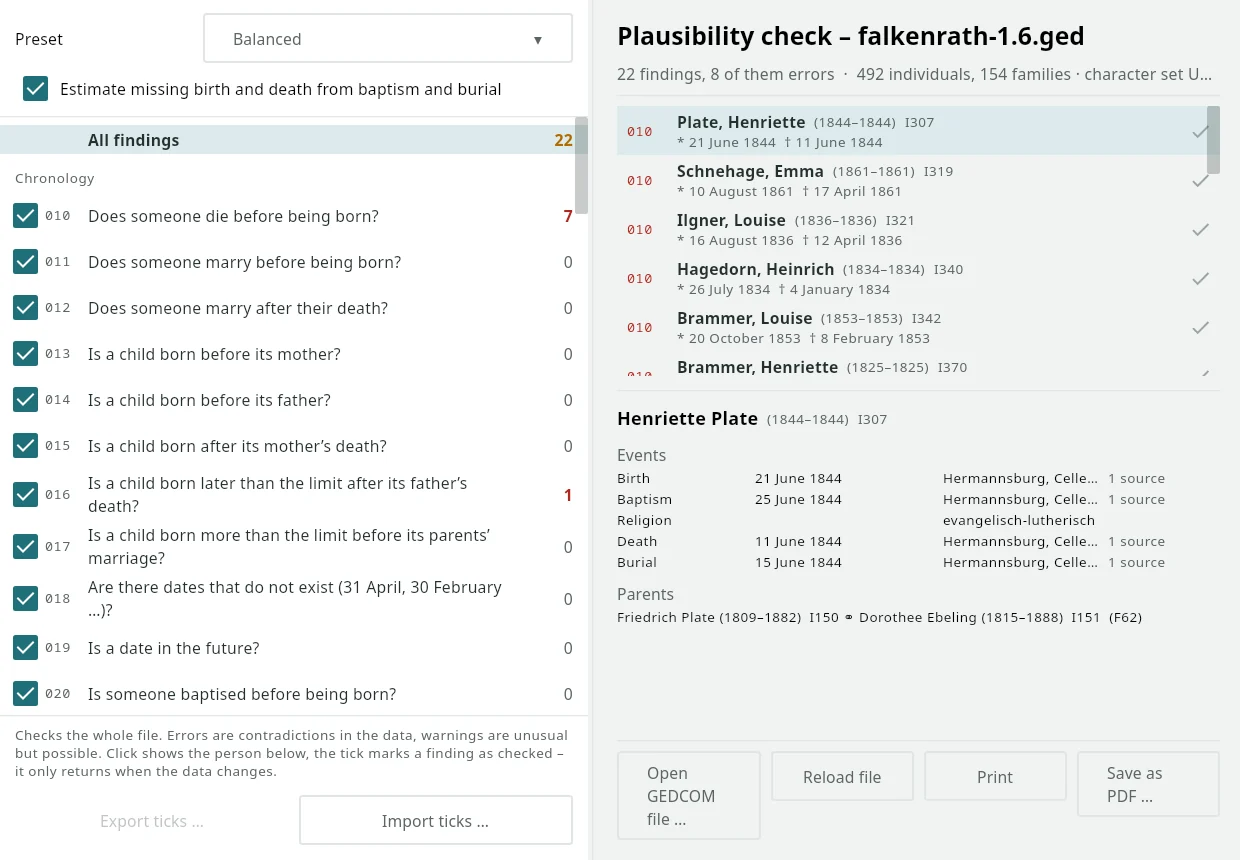
Every rule is a question about the data, answered by arithmetic or comparison. Errors are contradictions that cannot be true. Warnings are unusual but possible and deserve a look.
The rules are the same as in the plausibility check of wtWin; the full list with limits and presets is on the rule pages there. The Form group needs the file itself and is therefore complete only in gedaudit.
How it works
Open a .ged file, or double-click it in the file manager. On the left are the rules in their groups with the number of findings; on the right the findings for the chosen rule, or all of them. A click on a finding shows the person below: events with date, place and sources, parents, partners with marriage, children, and the identifiers from the file, so you find the person again in your own program. If a finding concerns two persons, such as a possible duplicate or child and mother, both are shown side by side.
Presets set all limits at once: balanced, strict, generous, with sources, or church book (18th and 19th century: baptism stands for birth, godparents count, the order of children is just presentation). Every limit and every severity can be changed by hand, and the check recalculates immediately. Missing births and deaths can be estimated from baptism and burial so the age rules apply.
Findings you have looked at and that stay as they are can be ticked off. They disappear from the list and only come back when the data at that spot changes. The tick list is kept on your computer, per file, and can be saved and loaded as a small file, for a second computer or a fellow researcher.
Corrections are made in the program the file came from. Export again and reload in gedaudit; the ticks stay. Print and Save as PDF give you the list with a summary, for working through on paper.
Compare
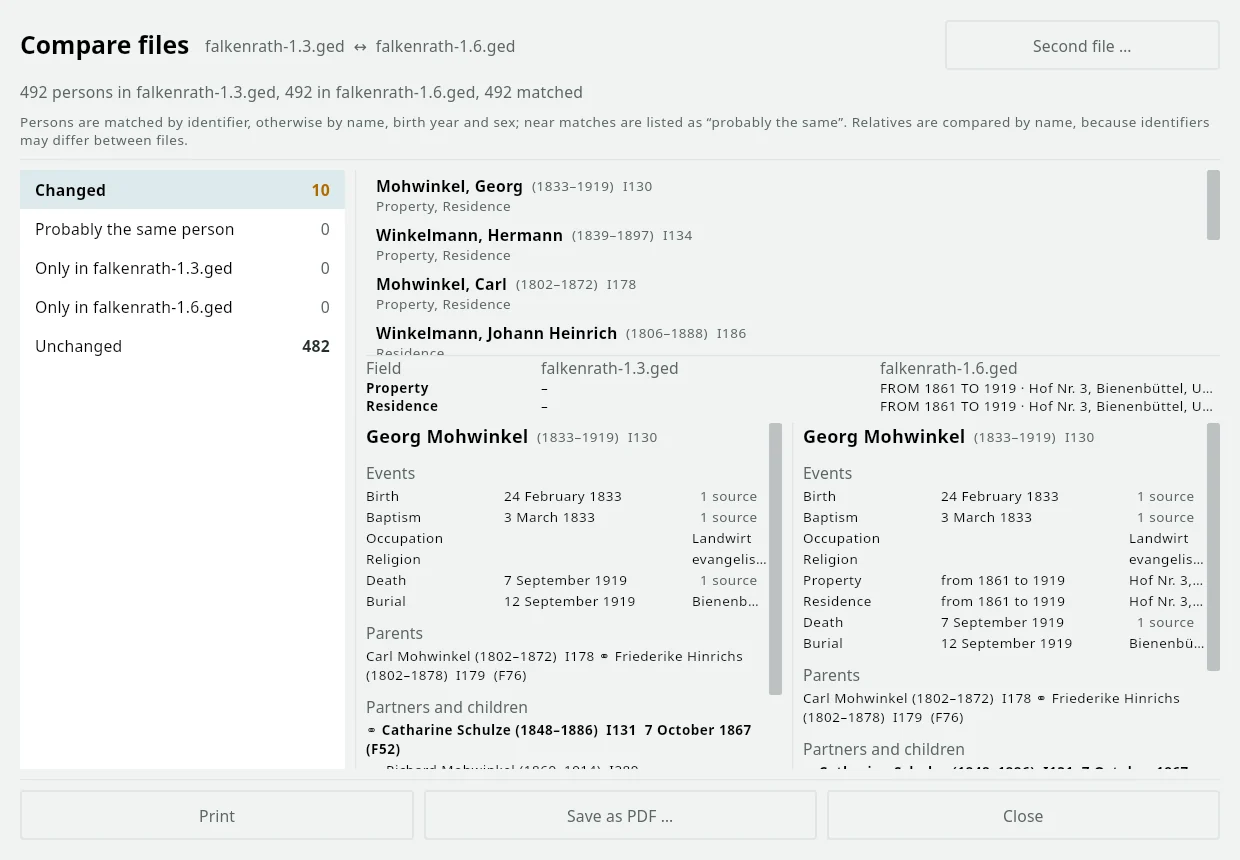
File › Compare with another file sets a second GEDCOM file against the open one: an older state of your tree, the export from another program, or a fellow researcher’s file. Persons are matched by identifier, otherwise by name, birth year and sex. The result comes in groups: changed, probably the same person, only in one file or the other, unchanged. A click shows the changed fields and both persons side by side. The list of differences can be printed or saved as PDF. Nothing is merged, nothing is written.
Files
Related
gedaudit is the plausibility check of wtWin, wtTux and wtMac as a program of its own, for anyone who does not use webtrees. If your tree lives in webtrees, wtWin runs the same rules on the live tree and lets you correct the event straight from the finding. Both use the same rule catalogue.
Download
gedaudit-0.5.x.exe, installs per user without administrator rights. SmartScreen may warn about an unknown publisher: “More info”, then “Run anyway”.gedaudit_0.5-5_amd64.deb for Debian, Ubuntu, Mint and relatives; afterwards under Office in the menu, or gedaudit file.ged in the terminal.gedaudit-….dmg for Apple Silicon and Intel, not yet signed: right-click the program, “Open”, confirm once.Where are the packages? Under Releases of the gedaudit repository on GitHub. The rule engine is shared with wtWin and lives in the repository app4webtrees, which gedaudit includes as a submodule.
GEDCOM is a format of The Church of Jesus Christ of Latter-day Saints. The programs mentioned belong to their owners; gedaudit is an independent project. This page is a translation from German; corrections are welcome.